



5052 aluminum strip is a magnesium-alloy aluminum material used for cable armoring where a lightweight, corrosion-resistant and non-ferromagnetic metal layer is required. Its balance of strength and formability makes it a candidate for selected interlocking and helical armor constructions.
Haomei supplies aluminum strip in slit-coil formats and reviews the alloy temper, thickness, width, edge condition and coil arrangement against the cable construction and the customer's forming line. The right specification is confirmed from the cable design and production requirements rather than selected by alloy name alone.
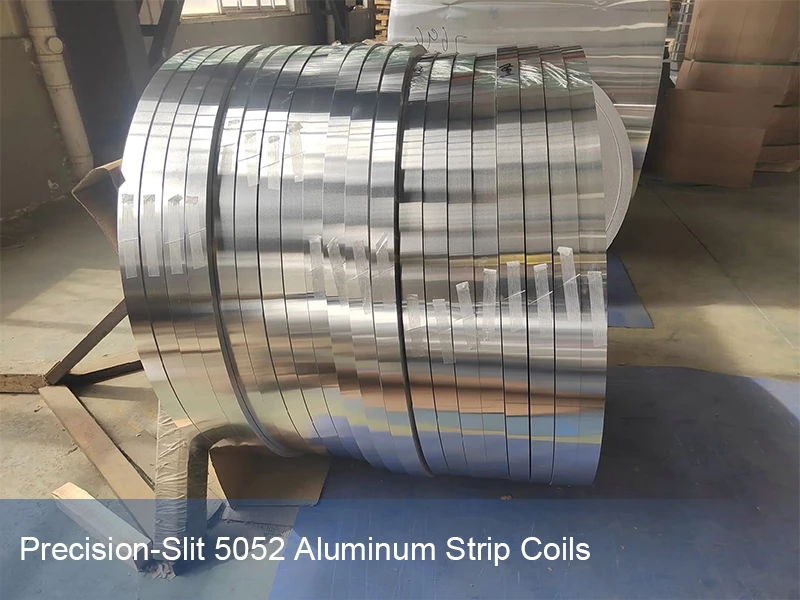
5052 Aluminum Strip Specifications
| Item | Specification / Selection | What to Confirm |
| Alloy | 5052 / AA 5052 / EN AW-5052 | Confirm the required alloy designation and material standard. |
| Product Form | Slit strip coils; flat stock may be considered for samples, prototyping or machining | Confirm whether the line uses continuous coil feed or cut lengths. |
| Temper | O, H14, H18, H24, H26 and H32 are temper options to evaluate | Final availability and mechanical-property requirements must be checked for the ordered thickness and width. |
| Thickness | Specified by the cable construction and mechanical-protection design | Provide nominal thickness and allowable tolerance. Haomei's cable-armoring product range lists 0.15–3.0 mm across its alloy range; each 5052 combination requires confirmation. |
| Strip Width | Custom slit width | Provide finished width and width tolerance. The cable-armoring product range lists common width examples and wider custom formats; suitability depends on the specific 5052 order. |
| Slit Edge | Slit edge or other agreed edge condition | Specify burr-height limit, edge damage allowance and whether additional edge treatment is required. |
| Surface | Mill-finish strip with the agreed surface condition | Identify any restrictions on scratches, oil, contamination, oxidation or handling marks. |
| Coil ID / OD | Arranged to suit the customer's decoiler and handling equipment | Provide paper-core ID, maximum outside diameter and lifting or handling constraints. |
| Coil Weight | Specified by the customer's production and handling requirements | Confirm target net weight per coil and allowable weight variation. |
| Standard / Documents | ASTM B209, EN 485, GB/T 3880 or customer specification, subject to order review | State the governing standard, inspection requirements and requested material documents. |
| Packaging | Moisture-resistant wrapping, edge protection, wooden pallet or wooden case as agreed | Confirm export route, storage conditions and unloading method. |
The 0.15–3.0 mm thickness reference and the width options shown on Haomei's cable-armoring range page cover multiple alloy grades, not every possible 5052 thickness/temper/width combination. Please send the required dimensions or drawing so Haomei can confirm a manufacturable specification before quotation. See the Aluminum Strip for Cable Armoring product range for the broader alloy options.
Why Use 5052 Aluminum for Cable Armoring?
5052 is a non-heat-treatable aluminum-magnesium alloy. It is strengthened primarily by cold working rather than by solution heat treatment and artificial aging. For cable armoring, its value comes from the combination of corrosion resistance, useful mechanical strength, forming capability and non-ferromagnetic behavior.
For Outdoor, Underground and Marine Exposure
5052 offers good resistance to seawater, moisture and many industrial atmospheres. This makes it worth evaluating for cable systems exposed to coastal air, underground conditions or demanding outdoor service.
Actual service suitability depends on the full cable design, surrounding materials, installation conditions and exposure. Alloy selection alone does not establish a service-life guarantee.
Balance the Required Strength with Forming Behavior
5052 provides medium strength with useful ductility. The selected temper influences the force needed to form the strip and the shape it can hold. The target should be stable forming without specifying more strength than the cable design needs.
Consider Repeated Flexing and Service Conditions
5052 has good fatigue resistance among commonly used aluminum sheet and strip alloys. For a cable construction subject to movement or vibration, the complete armor geometry, forming condition and operating loads still need engineering review.
Lightweight Metal Protection without Ferromagnetic Response
Aluminum is non-ferromagnetic, which can be relevant when a cable design specifies a non-ferrous armor material. This property should not be confused with electrical insulation or electromagnetic shielding; those functions depend on the cable's complete shielding and grounding design.
Choosing the 5052 Aluminum Strip Temper
The temper designation describes the material's condition after annealing and/or strain hardening. Since 5052 is non-heat-treatable for strengthening, its mechanical condition is controlled mainly through cold work and annealing or stabilization routes. The temper must therefore be selected against the forming operation and the required finished properties.
| Temper | General Condition | Selection Consideration for Cable Armor |
| 5052-O | Annealed, condition with high ductility | Consider where the forming route requires greater flexibility or more severe bending. Confirm that the resulting strength is sufficient for the armor design. |
| 5052-H14 | Strain-hardened to a half-hard condition | Consider when a half-hard strength level is specified. Validate forming force, bend geometry and springback on the actual line. |
| 5052-H18 | Strain-hardened to a full-hard condition | A harder condition with reduced formability compared wither tempers. Use only where the cable design and forming process explicitly support it. |
| 5052-H24 | Strain-hardened and partially annealed to a half-hard condition | Can be evaluated where a half-hard temper with a different processing route is required. Compare actual mechanical-property limits rather than assuming it is identical to H14. |
| 5052-H26 | Strain-hardened and partially annealed to a three-quarter-hard condition | Higher work-hardening level than H24; check forming limits, edge behavior and the customer's roll-forming or wrapping process. |
| 5052-H32 | Strain-hardened and stabilized to a quarter-hard condition | Consider where a stabilized, relatively formable H temper is specified. Confirm the exact mechanical properties required by the drawing or standard. |
These are general temper definitions, not a statement that every temper is routinely available for every cable-armoring size. Haomei's published cable-armoring range and general 5052 strip page show different temper selections for different product scopes. For a cable-armoring order, confirm the exact temper, thickness, width and mechanical-property range together before placing the order. See the 5052 Aluminum Strip / Slit Coil page for the general strip supply scope.
5052 Aluminum Strip Applications in Cable Armoring
5052 aluminum strip can be evaluated for cable constructions that use a formed aluminum protective layer. The cable type, armor geometry, installation environment and production equipment all affect the material specification.
Interlocking Cable Armor
For interlocking armor, the strip is roll-formed into a profile that engages around the cable. Strip width, thickness, temper and slit-edge condition influence feeding and profile consistency.
Helically Applied Armor
For helical application, the strip is wrapped around the cable in a controlled lay. The strip's forming behavior, edge quality and coil payoff need to match the wrapping equipment and cable geometry.
Marine and Coastal Cables
Where cable systems encounter salt-laden air or moisture, 5052's corrosion resistance may be useful. Confirm the complete cable construction and environmental requirements with the cable designer.
Underground Power Cables
For underground installations, the armor material and structure are selected as part of the cable's mechanical-protection design. Soil chemistry, moisture, installation loads and relevant cable standards must also be considered.
Industrial and High-Voltage Cables
Industrial and high-voltage cable constructions may use metallic protective layers for defined mechanical or design functions. The voltage rating itself does not determine the aluminum strip grade; the cable specification does.
Special Cable Designs
For custom armor profiles or non-standard production lines, Haomei can review drawings, sample dimensions and coil requirements before confirming the material and processing route.
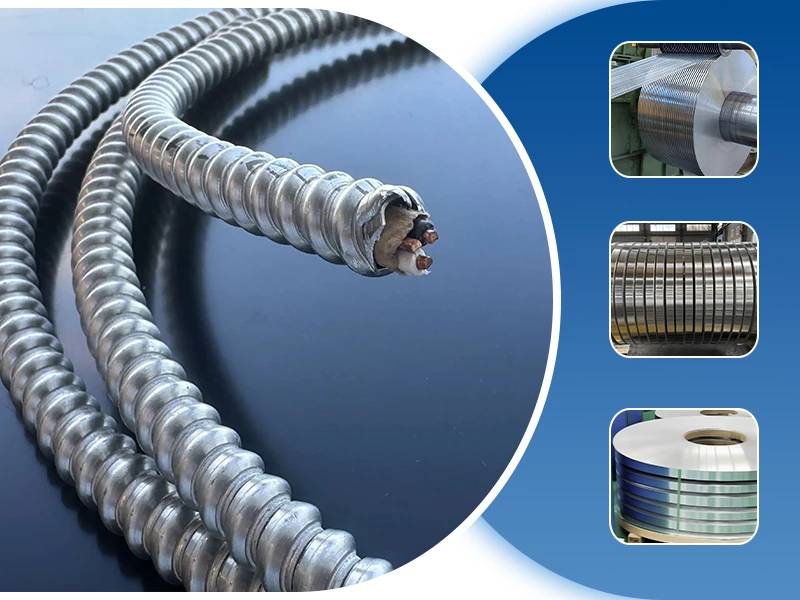
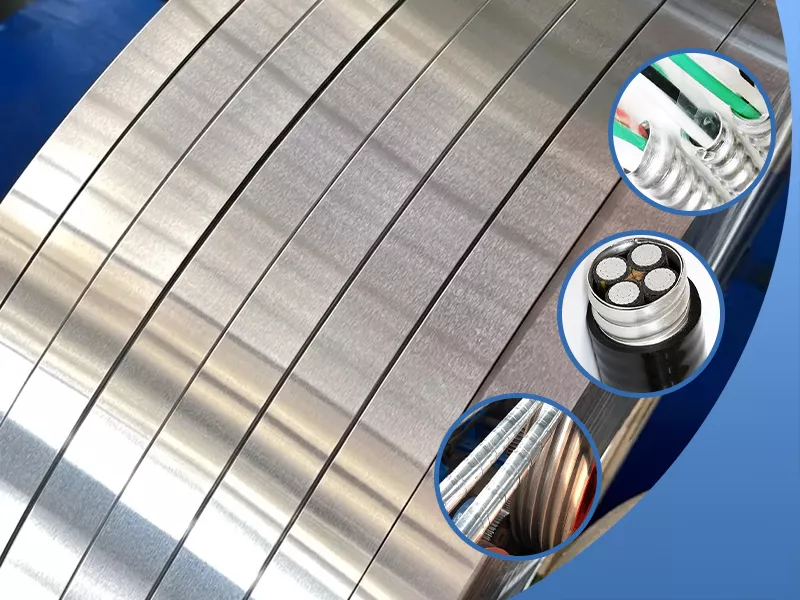
Cable armoring strip and cable shielding tape serve different functions. Armor strip is selected for a formed protective layer; shielding tape is selected for the electrical or screening role defined by the cable design. They should not be treated as interchangeable materials.
Custom Slitting and Rewinding for 5052 Cable Armoring Strip
A parent coil is slit into narrower strips to match the width required by the cable construction or forming line. For narrow-strip production, the finished width alone is not enough: slit-edge condition, burr height, strip tracking and coil winding also affect how the material runs.
Slit Width and Dimensional Control
Haomei reviews the target strip width and tolerance against the material thickness and processing setup. Width consistency matters when the strip is guided through forming rolls or wrapped at a controlled overlap.
Customers should provide the finished width, tolerance, coil direction and any drawing that defines the strip profile or edge condition.
Slit Edge and Burr Requirements
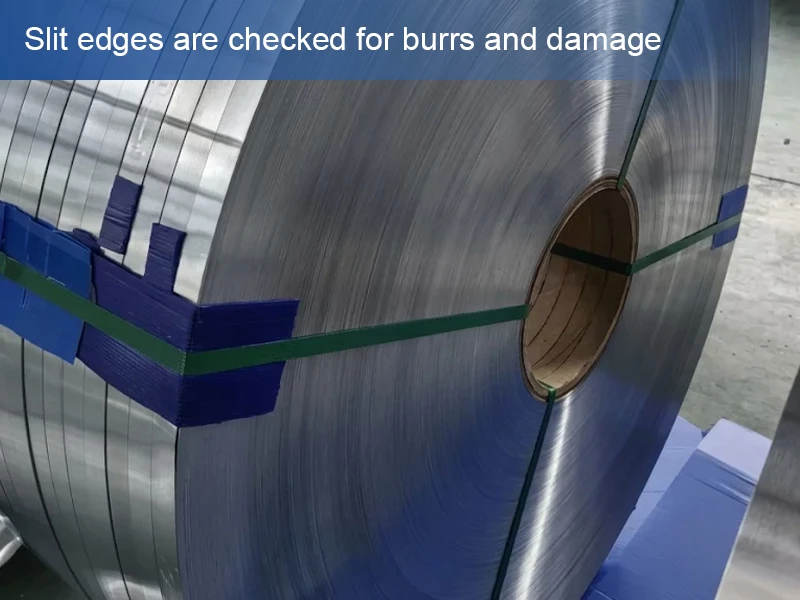
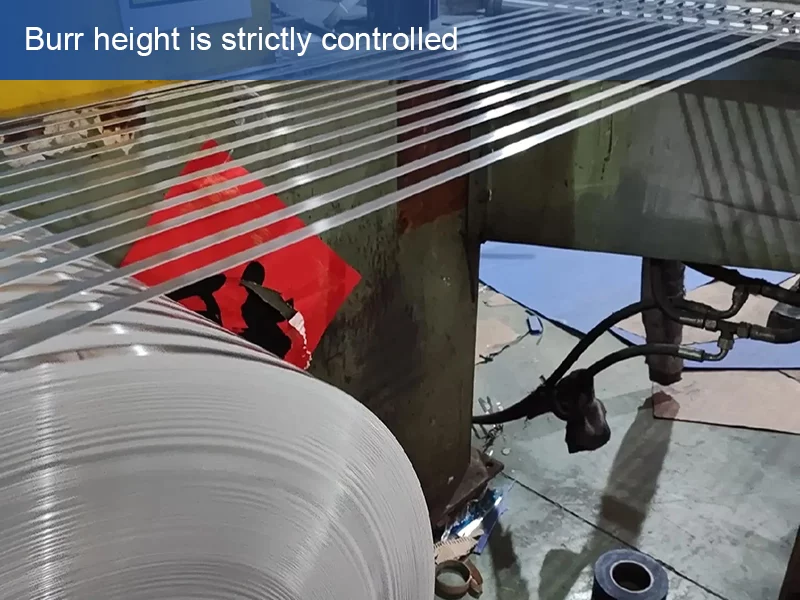
Burrs, edge tears or irregular cuts can interfere with strip guidance, create handling issues or affect the consistency of a formed armor profile. Haomei checks the slit edge for burrs, damage and irregular cutting against the agreed requirement.
Where burr height is critical, state the maximum permitted value and the measurement method in the purchase specification.
Rewinding and Coil Build
After slitting, strips can be rewound to the specified coil format. Coil tension, winding alignment and telescoping condition influence safe handling and stable payoff.
Provide the required coil ID, maximum OD, coil weight and any restrictions on winding direction or coil orientation.
Coil Fit with Production Equipment
The core diameter, outside diameter and coil weight must fit the customer's decoiler, lifting method and available floor space. A coil that is too heavy or too large may interrupt handling even when the strip itself meets the dimensional specification.
Haomei reviews coil configuration as part of the order rather than treating it as a packing detail only.
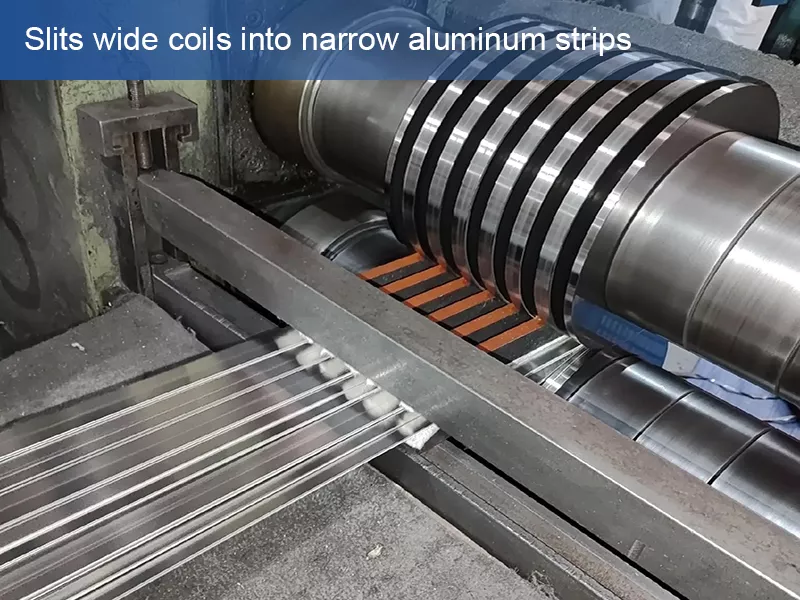
How Haomei Processes 5052 Aluminum Strip for Cable Armoring
Haomei's cable-strip supply involves more than cutting a parent coil to width. The order is reviewed from the required alloy and temper through slitting, rewinding, inspection and export packing so that the finished coil is matched to the customer's line and cable design.
Order and Material Review
We review the alloy, temper, thickness, width, governing standard and intended forming method. Drawings and existing material specifications help identify any requirements that need clarification before production.
Parent Coil Preparation
The parent coil is checked against the order information before processing. Where the temper requires a controlled annealing route, the material condition must be confirmed against the specified mechanical-property requirements.
Slitting to Required Width
Wider coils are slit into the required strip widths. Slitting setup and tool condition are relevant to width consistency, edge condition and burr formation.
Edge and Surface Inspection
Finished strip is checked for agreed dimensional requirements, visible surface defects, edge damage and burr condition. Critical limits are recorded in the order specification before production.
Rewinding and Coil Arrangement
Slit strips are rewound or arranged into the specified coil dimensions and weights. The coil build is reviewed against the customer's handling and decoiling requirements.
Final Check and Packing
Before dispatch, the coil identification, dimensions, packaging protection and order documents are checked as applicable to the purchase specification.
Haomei's wider aluminum manufacturing capabilities include rolling, annealing, slitting and quality inspection equipment. The exact processing route for a 5052 cable-armoring order depends on the supplied parent material, required temper, dimensions and agreed inspection plan.
Haomei Quality Control for 5052 Cable Armoring Strip
For a continuous cable line, small differences between coils can become production issues. Haomei focuses on the checks that connect the incoming material specification with the slit strip delivered to the cable manufacturer.
| Inspection Point | What Haomei Checks | Why It Matters to Cable Production |
| Alloy and Temper | Material identity and temper are checked against the confirmed order and material specification. | Incorrect alloy or temper can change strength, ductility and forming response. |
| Thickness | Thickness is measured against the agreed nominal value and tolerance. | Thickness variation can affect forming clearance, armor dimensions and consistency along the cable. |
| Strip Width | Finished slit width is checked against the specified width and tolerance. | Width variation can influence profile geometry, wrapping overlap and material tracking. |
| Burr Height and Edge Condition | Slit edges are checked for burrs, edge tears, deformation and irregular cutting. | Edge defects may affect feeding, handling, roll forming or operator safety. |
| Surface Condition | Visible scratches, contamination, stains and other surface defects are reviewed against the agreed requirement. | Surface condition affects material handling and the condition of the finished cable layer. |
| Flatness and Camber | Where required, strip shape, camber and flatness are reviewed against the order specification. | Excessive shape variation can make narrow strip harder to guide consistently. |
| Mechanical Properties | Mechanical properties are verified according to the applicable material standard or customer specification. | Strength and elongation need to match the forming operation and intended armor design. |
| Coil Configuration | Coil ID, OD, weight, winding arrangement and visible coil condition are checked as agreed. | Correct coil dimensions support safe handling and uninterrupted decoiling. |
| Identification and Documents | Coil identification and requested material or inspection documents are reviewed before shipment. | Traceable product information helps incoming inspection and procurement records. |
5052 vs. 5154, 5154A and 1060 for Cable Applications
5052 is not the only aluminum alloy used in cable protection. Haomei's cable-armoring range also covers 5154, 5154A and 1060. The best choice depends on the mechanical properties, conductivity, forming method and cable construction specified by the customer.
| Alloy | General Selection Position | Questions to Resolve |
| 5052 | A magnesium-alloy strip option where a balance of mechanical strength, corrosion resistance and forming performance is required. | What strength level and forming condition does the armor profile require? |
| 5154 / 5154A | Alternative 5xxx-series grades available for cable projects that specify these alloys or require a different strength-property balance. | Does the cable drawing or material standard specify 5154 or 5154A? What mechanical-property limits apply? |
| 1060 | Commercially pure aluminum option for designs that place greater emphasis on conductivity and formability than on higher mechanical strength. | Is the strip being used for armoring, shielding or another cable function? What strength is actually required? |
For the complete range of alloys and cable-strip configurations, visit Haomei Aluminum Strip for Cable Armoring. For parent coil supply, see 5052 Aluminum Coil.
Packaging for 5052 Aluminum Strip Coils
Packaging is arranged according to strip width, coil weight, coil dimensions, transportation route and storage conditions. The objective is to limit moisture exposure, surface abrasion and edge damage during handling and transport.
Moisture and Surface Protection
Moisture-resistant wrapping and suitable protective materials can be used to reduce exposure during storage and shipment. Surface protection is selected according to the material finish and handling requirements.
Edge and Coil Protection
Edge protection and suitable coil supports help reduce damage during lifting, loading and unloading. Coil orientation and securing arrangements are confirmed against the package dimensions and transport method.
Wooden Pallets or Cases
Wooden pallets or wooden cases can be arranged according to coil size, gross weight, destination requirements and the customer's unloading equipment.
Shipping Information
Before shipment, confirm package marking, coil identification, net and gross weight, packing list details and any destination-specific documentation requested by the buyer.
What Information Is Needed for a 5052 Aluminum Strip Quote?
To review whether the material fits your cable design and prepare a useful quotation, send as many of the following details as possible. An existing drawing, material specification or sample dimensions can help avoid repeated clarification.
- Alloy: 5052
- Required temper
- Nominal thickness and tolerance
- Finished strip width and tolerance
- Slit-edge condition and burr-height limit
- Surface condition or finish
- Coil inner diameter and maximum outer diameter
- Target coil weight and weight tolerance
- Interlocking, helical or other forming method
- Cable type and intended service environment
- Order quantity and repeat-order forecast
- Packaging, destination and document requirements
If you have a production-line drawing or an existing strip specification, attach it to your inquiry. Haomei can review the material and processing details before confirming the quotation scope.
Email Haomei Your 5052 Strip Requirements
FAQ – 5052 Aluminum Strip for Cable Armoring
Is 5052 aluminum suitable for cable armoring?
5052 can be considered for cable constructions requiring a lightweight, corrosion-resistant and non-ferromagnetic aluminum protective layer. Suitability depends on armor geometry, required mechanical protection, strip thickness, temper, forming method and service environment.
Which 5052 temper is best for interlocking or helical cable armor?
There is no single temper that is best for every armor design. O is the, annealed condition; H14 and H24 are half-hard conditions reached through different processing routes; H18 and H26 are harder conditions; H32 is a stabilized quarter-hard condition. Select the temper by checking the required strength, forming severity, springback and production-line trials.
What thickness and width can Haomei supply?
Haomei's published cable-armoring product range lists a broad thickness range of 0.15–3.0 mm and both standard and custom widths across several alloy grades. These figures are not a guarantee that every dimension is available in 5052 and every temper. Send the requested thickness, width and tolerances for order-specific confirmation.
Why is burr height important for cable armoring strip?
Burrs and irregular slit edges can affect strip guiding, handling and forming. For continuous production, define the allowable burr height and inspection method in advance so that the slit-edge requirement is clear before processing.
Can Haomei supply custom slit widths?
Haomei provides customized slitting for aluminum strip. The available width depends on the parent-coil dimensions, material thickness, required tolerance and slitting setup. A drawing or target width range helps Haomei review feasibility.
Can the coil ID, OD and weight be customized?
Coil configuration can be reviewed against the customer's decoiler and handling system. Include the required core ID, maximum outside diameter, coil weight and any winding-direction or package-orientation requirements in the inquiry.
How does 5052 compare with 5154 and 5154A?
All three are 5xxx-series aluminum-magnesium alloys used in Haomei's cable-strip range. The correct grade depends on the specified mechanical properties, corrosion requirements and forming process. Where a cable drawing names 5154 or 5154A, do not substitute 5052 without engineering approval and material verification.
What information should I send for a quotation?
Provide alloy and temper, thickness, strip width, dimensional tolerances, edge and burr requirements, coil ID and OD, coil weight, application, forming method, quantity, destination and packaging requirements. Drawings and existing material specifications are useful for technical review.
Discuss Your 5052 Cable Armoring Strip Specification
Send Haomei your cable construction, required temper, strip dimensions, slit-edge limits and coil configuration. We will review the information against the requested product scope and clarify any points that need confirmation before quotation.
Contact Haomei AluminumRelated Products for Armored Cables